Poetry of the Proletariat – a review of “Working”

By Michael Buzzelli

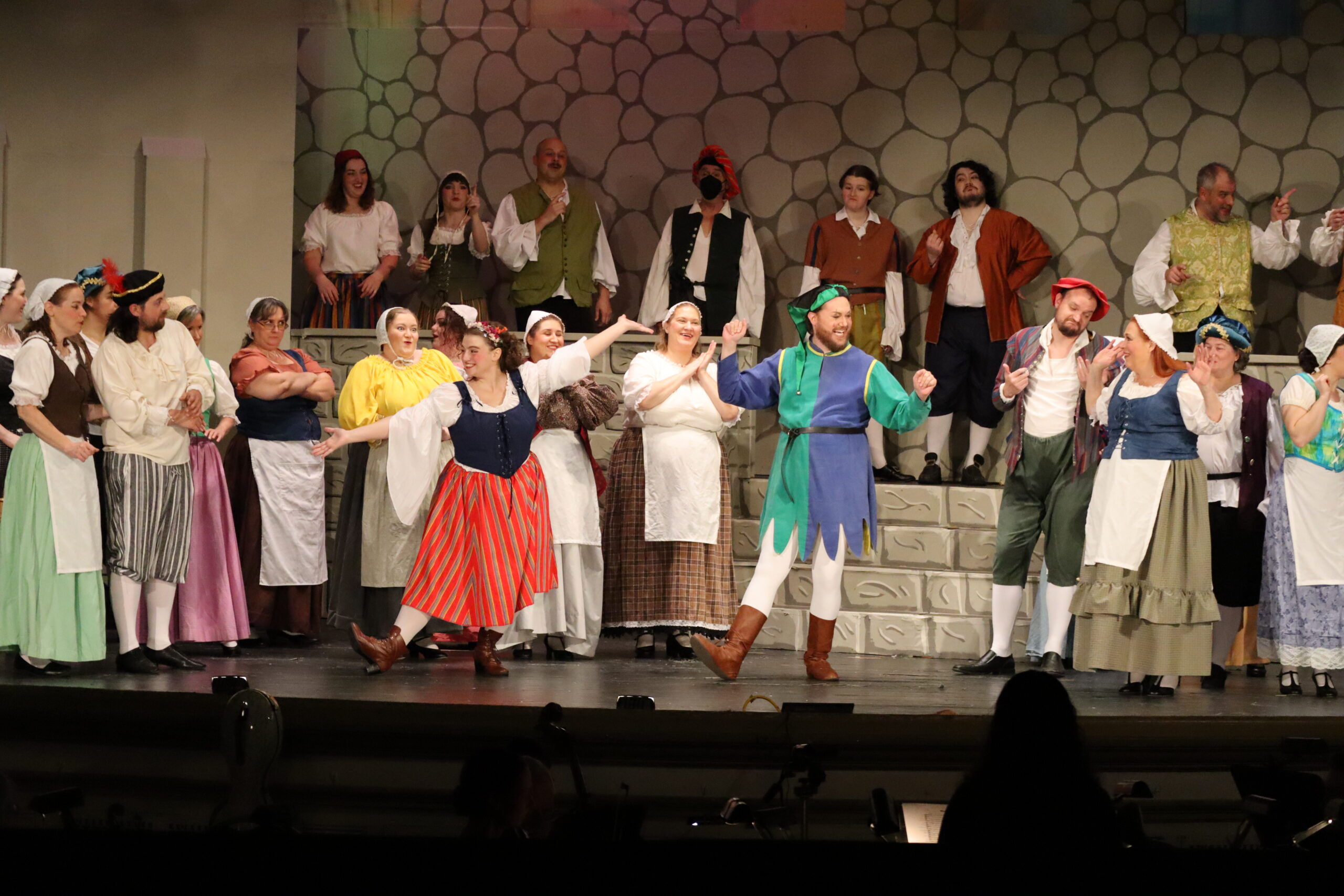
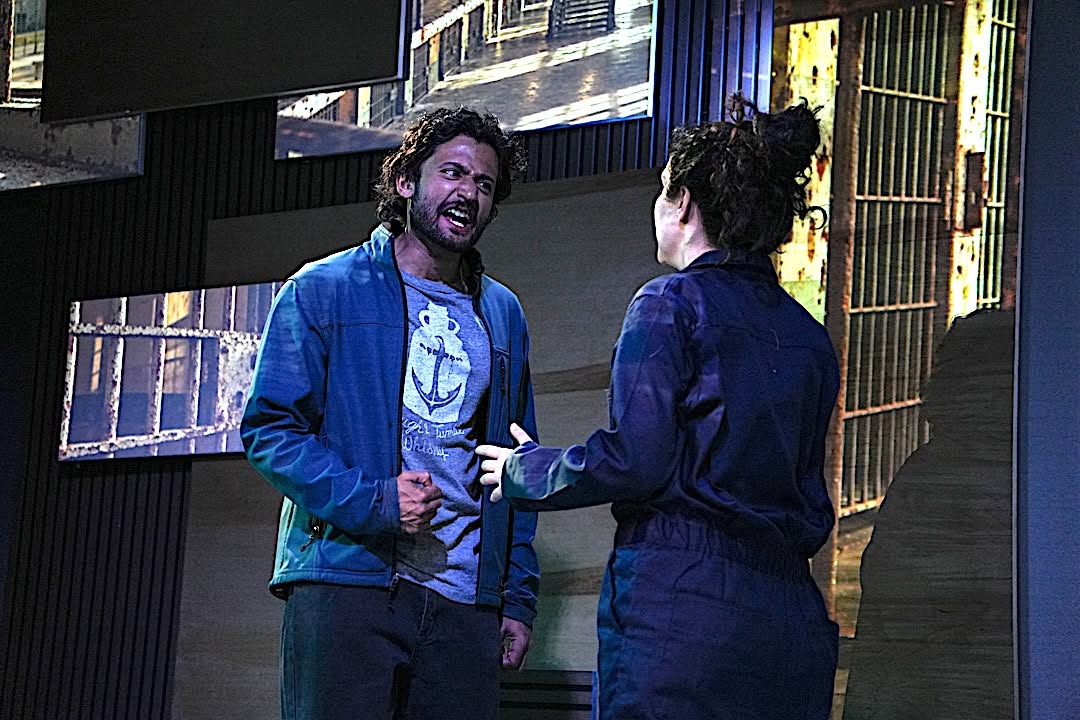
Another Monday rolls around, and everyone gets ready to punch the clock in “Working,” a tribute to the American employee (though the unemployed and the retired are also represented in the show). Women (Cadee Velasquez, Melessie Clark, and Vanessa Reseland) and Men (Matty Thornton, Dylan Pal, and Stefan Lingenfelter) trod off to their jobs, and the workers describe their daily lives in monologue and song, backed up by an impressive chorus.

Ironically, they are songs about the unsung: the millworker, the truck driver, the waitress, the nurse, the pride of the proletariat, from hookers to homemakers.

It’s billed as a new musical, but it’s newish, since most of the monologues are taken from the 70s source material, based on interviews compiled and written by Studs Terkel and adapted by CMU grad Stephen Schwartz and Nina Faso with additional revisions (stay with me for a moment, we’ll get there).

Melessie Clark plays a variety of roles in “Working.”
Vanessa Reseland is also playing a variety of roles in “Working.”

This ode to the Union Label is Pittsburgh Proud and Pittsburgh Strong, or in terms your friendly neighborhood farmers market-goer would understand: “It’s locally sourced!”

The Steel City has a plethora of local talent, and Front Porch Theatricals has always sought to find the cream of the crop. The cast of “Working” is no exception. Director Daina Michele Griffith has gathered a superb lineup. It’s a strong group of performers, most notably the show’s leading ladies, Velasquez, Clark, and Reseland.

Velasquez brings a powerful singing voice along with a heap of charm.

Clark is delightful in a variety of roles. Her sassy “Woman of the Evening” is a particular joy.

Reseland is a new star in the Pittsburgh firmament, but by no means a new talent. They have performed all over the world on stage and screen. They serve up some of the most delicious scenes as a waitress.

Note: On opening night, Lenora Nemetz, who originated the role of the Waitress in “Working” on Broadway, was in the audience. After the show, there was a full-circle moment when Nemetz posed with Reseland in front of Front Porch Theatrical’s step-and-repeat.

Matty Thornton does a great job with some regional accents. His role as a trucker stands out in the slightly risqué ballad “Brother Trucker.”

Sefan Lingenfelter delivers a soul-crushing song about retirement that is perfectly executed, yet devastatingly all too real. We understand  [his character’s] Joe’s frustration. The musical doubles down by compounding the scene with health care workers singing, “A Very Good Day.”  Keep your handkerchiefs and facial tissue handy! It’s a 3-Kleenex moment.

Dylan Pal has some fun character bits, particularly as a customer service rep with rage issues. He’s not all fun and games. He portrays the health care worker, Utkarsh, with a poignant flourish.

Doug Levine’s musical accomplishments are exceptional. He’s backed up by an incredible band, Ken Karsh (guitar), Tim Nwranski (drums) and Paul Thompson (bass).  The band flawlessly creates heightened tension throughout the musical.

This reviewer rarely mentions the lighting design, but Andrew David Ostrowski’s work was exceptional. When Thornton portrays a fireman in the middle of a conflagration, Ostrowski’s lights tell the story, with dusky orange hues backlit on the actor’s frame.

While Studs Terkel’s original material has been updated by a legion of songwriters, including Craig Carnelia, Micki Grant, Lin-Manuel Miranda, Mary Rodgers and Susan Birkenhead, Stephen Schwartz, and James Taylor, the show still shows its wrinkles through the facelift (more in the text than the music, but there are some significant signs of aging in the songs as well).

“Working” is meant to be a glorious affirmation of the common man and woman, but it tries too hard to appeal to everyone and gets a little lost in its attempt to serve all its customers. Some good acting and powerful singing keeps the show from feeling generic.

The musical is a hard sell for anyone who likes a cohesive beginning, middle, and end. It’s the poetry of the proletariat. There are, however, some triumphant moments, especially with this glorious cast.

-MB

“Working” runs until May 24 at the New Hazlett, 6 Allegheny Square, Pittsburgh, PA 15212. For more information, click here

These Times are NOT A’Changing – a review of “Sixty-nine Seventy”

By Michael Buzzelli

                              “That’s just a little bit of History Repeating”                                            – – Shirley Bassey and the Propellerheads.

Four students, Sharon (Mal MacKenzie), Naomi (Marissa Lily), Barry (Jack Senske), and Andy (Thomas B. Andrews), struggle with their inner thoughts at Buffalo State University, during the very real and tumultuous times of 1969 and 1970 in Michael Eichler’s “Sixty-nine/ Seventy.”

Sharon, raised by conservative Presbyterian parents, rides the line between doing what’s right and what’s expected of her.

Naomi gets to school on the SEEK (Search for Education, Elevation [originally Enlightenment], and Knowledge) scholarship.

Barry is farther left than the others, protesting everything. He is filled with righteous anger, but finds time to date (no spoilers).

Andy is a fastidious townie who is looked down upon by other university students, but he finds validation for his views and forms friendships with his older peers.

The play is a series of monologues, with only a tiny bit of interaction between the actors.

Four additional actors will take on the roles on alternative nights: Barry (Cam Webb), Naomi (Naomi Terrell), Sharon (Sarah Altomari), and Andy (Nick Grosso).

Both casts of “Sixty-nine/Seventy” with the director, associate director, and dramaturg pose for a picture.

Lily is dynamic as the young Black girl trying to find acceptance on campus. She mines every utterance for comedic gold. A well-placed eye roll and an occasional hair flip have the audience in stitches.

Andrews is an avatar of the playwright. His character is filled with anxiety, blundering through college.

MacKenzie plays a controlled character, seething with hidden passions. They are marvelous in the role.

Senske delivers his monologues with verve.

Associate Director and Scenic Designer Rob James created several risers with uncannily accurate props (somehow he procured an ancient payphone).

The play opens with four video monologues, one from each actor, filmed by Adam Morgan. There is additional interstitial material, news clips, posters, etc. News by Dustin Wickett.

Tyler Hieb, lighting designer and lighting manager, uses the lights to direct the audience around the room, shining the spotlight on the actor when they are ready to share their section of the story.

Director Alex Manalo makes terrific use of the space (the lobby of the City Theatre building), moving the actors in a whirlwind of kinetic energy (Manalo is also a gifted choreographer).

Eichler’s play resonates repeatedly with the present as the students protest an unjust war, a bloodthirsty police force, a fraudulent president, and a population of citizens who believe the lies they are told. Sound familiar?

While the play could use a trim, it’s poignant, funny, and potent. The parallels between the “Sixty-nine/ Seventy” and 2026 are eerily relevant.

Note: Proceeds from the show will benefit the University of Pittsburgh’s School of Social Work, MSW COSA (Community, Organization and Social Action) Program.

-MB

“Sixty-nine/ Seventy” runs from May 14 to May 24 in the lobby of the City Theatre, 1300 Bingham St, Pittsburgh, PA 15203. For tickets and additional information, click here


An Unexpected Delight – A review of “Pride and Prejudice”

By Lonnie the Theater Lady
  • The first indication that Kate Hamill’s ridiculously funny adaptation of “Pride and Prejudice” is unlike any other is quickly revealed in the first scene. Several couples, beautifully costumed in 19th-century attire (Declan Hines, designer), are dancing formally to classical music when the music abruptly shifts to rhythmic pop, and their dance steps become sexy, freestyle, and very informal. This scene accurately foreshadows the surprising scenes that follow.
  • The plot, characters, and themes closely mirror the original novel. Original themes, such as the importance of social status and reputation and the view that marriage is for financial security, are woven throughout this adaptation. The satirical treatment of these themes is a shocker at first, but it then leaves the audience happily anticipating the next screwball scene. One wacky scene follows the other.
  • In England, the estate, run by Mr. Bennet (Luke Hancock), can only be passed on to a male heir. He has no sons, which makes it imperative that at least one of his daughters marry a wealthy man so the estate can remain in the family. The amusing, sarcastic, droll delivery of his lines earns him well-deserved laughs and serves as the consummate counter to his wife’s lunacy.
  • Lizzie (Audrey Klein) and Mr. Darcy (Lyle Hieronymus).
  • Mrs. Bennet (Elena Fagione) is excessively obsequious, fussing over and pandering to her daughter’s prospective husbands. She cares only about the men’s social standing and finances. To call her behavior “out of control” would be a gross understatement. She’s a shouting ball of frenetic energy as she theatrically throws herself dramatically onto the sofa–upside down! So hilarious.
  • The rest of the story chronicles the daughters meeting, getting to know, and choosing their suitors.
  • Lyle Hieronymus plays one of the suitors, Mr. Darcy, with a dashing flair. They skillfully convey their character’s pride and, later, their confusion. Hieronymus a likable, engaging Mr. Darcy.
  • Audrey Klein’s Lizzy convincingly embodies a feminist who is ahead of her time and initially rejects the idea of ever marrying. Her genuine portrayal radiates her agonizing uncertainty regarding her feelings for Mr. Darcy. Her every emotion is clearly and naturally telegraphed. Well done.
  • Samantha Hawk dives fully into her role as Mary, the goth (or maybe emo) sister. Her black raccoon makeup circled eyes, and her detached, deadpan expression were wildly comical. If she’s not coughing or scratching herself, she’s startling others by stealthily approaching them from behind. She rightfully garners a boatload of laughs.
  • Carina Ianarelli is well cast as the lovable Jane. She exemplifies the beautiful, romantic, almost-perfect daughter, with sweetness and sincerity.
  • Kieran Craft is an adorable Mr. Bingley—anxious to please with the energy of a frisky, devoted puppy.
  • Asriel Barnabei plays Mr. Collins well. He often struggles to find the precise word to express himself clearly. His theatrics when speaking of Lady Catherine de Bourgh are memorable and only get more   amusing every time he says her name.
  • Everyone in the large cast leans headlong into the over-the-top crazy elements of their characters. This very strong cast has no weak links.
  • Director Nicole Zalak does a great job keeping up the rapid pace with smooth transitions between scenes. Kudos to her for giving her cast the freedom to embrace the ludicrous chaos.
  • Note: There is a moment worth mentioning. The theater is transformed into an expansive, beautiful garden when huge projections adorn the auditorium’s ceiling and walls. It is a lovely effect.
  • If you’re a Jane Austen fan or even if you’re not, you’re bound to be delighted by this madcap, offbeat, outlandish show.  It’s as if  Monty Python and Jane Austen collaborated to write and produce this play!
  • LtTL
  • Runs through May 17 at The Heritage Players. For more information and tickets, click here.

Liberty Magic: Jared Kopf Conjures We Phantom Figures


Reviewed by Dr. Tiffany Knight Raymond, PhD, and Theron Raymond (seventh grader)

Liberty Magic brings wizard Jared Kopf to the stage. Jared opens his show with an extended prologue, reminding us “In the beginning, there was magic.” He elaborates to define that magic as “the magic of winds and clouds” and “the magic of birth and death.” Now, we know clouds are condensed water vapor, and we can create babies in test tubes. Scientific explanation has furthered the world but diminished the magic. Jared reawakens that sense of magic through reframing, reminding us that science and magic can coexist. Just because we know how clouds form shouldn’t make them less magical when we look up and gaze, spotting dragons in cloud formations.

Kopf’s framing of “in the beginning” sets the stage for history and memory as touchstones throughout the show. Kopf pays homage to his magic teacher, Bob White, who he brings to life through intonation and mimicking Bob’s chain-smoking of Marlboros, using the remains of one cigarette to light the next. And then back to Bob’s long-haired teacher, tracing the lineage back, showcasing how we are all generational by-products through both biology and environment. There is a historical weight to Jared’s show that he never rushes.

Kopf applies that same thoughtful deliberation to his magic. His first trick is the classic cup and ball trick or shell game. This sleight of hand is as old as time, and yet, like the clouds, it still inspires audience awe. Jared is a master at the slow build. He continues to raise the stakes with his cups and spheres (as he calls them). He intentionally slows down the trick, trying to get us to see it happen and even inviting the audience to ask him to slow it down.

Unlike most magic shows which bring a range of audience members onstage, Jared has the same two people onstage with him for the duration of the show. He still interacts with the broader audience, specifically within the context of his card tricks where audience members choose cards. He ends with a card trick that he explains, yet that explanation does not dilute or diminish the sense of wonder that those gathered at Liberty Magic get to collectively experience.

Jared Kopf at Liberty Magic.

Jared’s card tricks include the tarot. He includes a brief history of the tarot, an Italian card game that was adopted by the French before taking on an occult meaning. His own cards are French, and he shows each of the twenty-two pictorial cards of the Major Arcana. There’s a loving leisure in his introduction of each card. He introduces friends, not objects, and he pauses to share the etymology of certain terms or reflect on imagery.

The introduction of the tarot ladders into a tarot reading that evolves into a card trick. It’s an emotional journey that reminds us that while science can explain things, the suspension of disbelief helps us feel things.

Jared recasts our world in magical terms, reminding us we’re all wizards. We all possess the magical power to cast “evil spells” like “I hate you” and “Drink Coke” (there’s humor in his show as well) and “good spells” like “I’m sorry” and “I love you.” Words have power. In a world that can feel divisive, he reminds us of our power and how we can choose “good spells” to create a better world.

You can see Jared Kopf in We Phantom Figures through May 17, 2026, at Liberty Magic (811 Liberty Avenue, Pittsburgh, PA, 15222). While recommended for 18+, the show is appropriate for the 12+ who are permitted as 13-year-old co-reviewer Theron was enchanted by it. Liberty Magic also offers a Skeleton Key VIP experience to go backstage and connect with Jared after his show. Jared is generous with his time and willingness to answer questions and performs a few additional magic tricks, making it well worth the Skeleton Key experience. Purchase tickets online here.

You’re a wonder…Wonder….Man – a review of Cheyenne Jackson

by Michael Buzzelli

The 2025-2026 Trust Cabaret series went out with a bang on Monday, May 11, with Broadway star Cheyenne Jackson.

The show started with an overture of sorts, a repertoire of 70s television theme songs. Songs, Jackson claimed, had molded him.  The ditties included  “Charlie’s Angels,” “Little House on the Prairie,” and, of course, “Wonder Woman.” The Grammy and Emmy-nominated actor really, really, really loved Lynda Carter’s “Wonder Woman.”

Jackson, known for his roles in “Xanadu,” “Damn Yankees,” “Once Upon A Mattress,’ and many more, is currently on Broadway in “Oh, Mary!” The congenial star spent three years on a Fox sitcom, “Call Me Kat.”

Last night, he owned the Cabaret stage (currently dressed for City Theatre’s production of “Hedwig and the Angry Inch”).

Jackson’s cabaret act was not just an act; it was a musical memoir. He shared deeply personal stories with comedic flair, belted out Broadway ballads, and sang an Elvis tune.

Note: Jackson won a Theatre World Award for his portrayal of Elvis in “All Shook Up.”

The Broadway crooner also sang an original song, “OK,” a powerful, personal tale about the moment Jackson came out to his father while watching a high school football game. The song is a poignant and moving tribute to his dad.

Cheyenne Jackson is belting out a number sans mustache.
,., A promotional image of the artist with his mustache.

There were two other tributes; one was a duet with Gavin Creel (featuring a recording of the late actor’s voice), and the other was a cute story about Jackson’s “Call Me Kat” costar, Leslie Jordan, complete with an astonishing imitation of Jordan’s distinct voice (known best for his guest-starring role on “Will & Grace” and his own one-man-show, “Like a Dog on Linoleum”).

In a moment of sheer joy, Jackson sang “That’s Life” while reading his own bad theatre reviews, which revealed rude sentiments from his harshest critics.

Note: Sadly, this review will not make the cut for his next cabaret because it is overly positive.

Jackson ended the show by belting out “I am what I am” from “La Cage.” It was, literally and figuratively, a showstopper, garnering Jackson a standing O.

The Trust Arts Cabaret series will be back next year with Jennifer Simard, CMU grad Christian Borle, Cassie Levy, Lorna Courtney, and the long-awaited Jeremy Jordan (who was bumped from this year to next because of scheduling conflicts).

-MB

Learn more about the Trust Arts Cabaret series by clicking here.


Beauty Comes in All Forms–A review of “Steel Magnolias”

By Lonnie the Theater Lady

Most people are familiar with the 1989 star-studded film, “Steel Magnolias”. Robert Harling’s dramatic tragicomedy began as a short story chronicling his sister’s catastrophic battle with Type 1 Diabetes. The short story quickly morphed into a full-length play opening Off-Broadway in 1987. The movie followed.

The main storyline is easy to follow. A group of female neighbors and friends frequently gather at Truvy’s (Tonilyn Jackson) home beauty parlor in Chinquapin, a small town in Louisiana. The women gather to gossip, chat, complain, share opinions, laugh, and support each other– when they’re not bickering. And, of course, sometimes they do get their hair done. Serious topics are interspersed with very funny one-liners. It never gets too serious for too long. Examples– “He’s so dumb he thinks Sherlock Holmes is a subdivision!’ And my personal favorite: “I don’t see plays because I can fall asleep at home for free.”

The show opens in the beauty shop (where all the action takes place) on the morning of Shelby’s (Sarah Puhala) wedding. Truvy recently hired a quiet, meek, young beautician, Annelle (Sydney Mannion). One by one, Annelle is introduced to the women’s circle of friends as they enter the shop to get beautified for the wedding. The widow of the deceased town mayor, Clairee (Barbara Harrold), Oiser (Cindy West), the town grouch, and Shelby’s mother, M’Lynn (Stephanie Ottey), all buzz with excitement about the wedding. The conversation centers on the wedding and Shelby’s plans to start a family. Shelby suffers an episode of diabetic hypoglycemia and loses consciousness. When she recovers, she shares the news that she and Jackson, her future husband, have decided to adopt, since her doctor discouraged her from getting pregnant. The extreme health risks caused by her diabetes make pregnancy a dangerous choice. She’s clearly devastated—her greatest desire is to bear her own children.

The cast of “Steel Magnolias.” Photo Credit: Pittsburgh Performance Photography

Several months later, Shelby is ecstatic to announce to her friends and family that, against all medical advice, she is pregnant. M’Lynn is openly distraught over Shelby’s ill-advised pregnancy. Shelby is confident that her pregnancy will go well — and it does. Even after the baby’s premature birth, both she and her son thrive. Shelby is thrilled and exhilarated to be a mother. Unfortunately, her good health is short-lived. She begins to suffer from kidney failure. What follows is an impressive display of motherly love, courage, strength, and women’s steely resilience.

To the credit of Sean Michael Barrett (director), the entire cast plays their roles with authenticity and a consistently natural ease. He doesn’t take the easy road and portray the characters as stereotypical Southern women. He makes the characters both real and sympathetic. Their accents are never exaggerated and are easy to understand.

Tonilyn Jackson plays Truvy with genuine warmth. She’s a truly charismatic Southern Belle exuding grace and dignity. Truvy’s character needs to be strong enough to hold the play and its characters together. Jackson more than meets the challenge.

Sydney Mannion’s Annelle presents a sweet, naive vulnerability that endears her to the audience. Her expressive face perfectly mirrors her character’s every emotion. She appears almost angelic at times.

Sarah Puhala’s nuanced portrayal of Shelby enchants with her pure, sweet side. She’s a woman who is obsessed with pink, undeniably the most “girly” of all colors. Beneath that feminine softness lies a strong, courageous woman determined to make her own decisions.

Stephanie Ottey’s powerful final monologue is masterfully done. M’Lynn is trying to make sense of what happened to her daughter. Her heart-wrenching grief and confusion are beyond excruciating. Her dynamic delivery leaves not one dry eye in the theater. Truly a stunning performance. WOW! Unforgettable!

Cindy West gives us a crotchety, yet somehow lovable Oiser. She has some of the best laugh lines and delivers them all with perfect timing and tone. Her good heart shines through her irritable demeanor.

Barbara Harrold’s Clairee is the least quirky of the women. She brilliantly shows off her comedy chops in a very funny scene that momentarily lightens the mood of Ottey’s monologue.

Set designer Rob James creates a charming set reflecting the tone of the 1980s. Real beauty shop furniture, retro hair dryers, and a sink with real running water are among the many details that create the homey feeling of the set. Large white trellises festooned with big, colorful magnolias flank the set. The extraordinary, nostalgic set is gorgeous.

Stage 62 is best known for its big splashy musicals. It is lovely to see that the company is also proficient at producing high-quality dramatic comedy. Steel Magnolias is a splendidly done, flawless reminder that life is beautiful, fragile, and sometimes heartbreaking..

In Shelby’s words, “I’d rather have thirty minutes of wonderful than a lifetime of nothing special.”  This show delivers many more than thirty minutes of wonderful and is, in fact, very special! Marvelous! Don’t miss this one!

LtTL

For tickets and more information, click here.
 

Booze Clues—A Review of Wine and Spirits

By: Joseph Szalinski

Intoxicants and live events have been intertwined since the days of Dionysus, so what better way to pay homage to such a tradition than to put on a show about wine? Add a dash of the supernatural, and you’ve got the makings of a tailgate in Gettysburg, or, more appropriately, The Haunted Theatre Company’s inaugural production of Wine and Spirits, written and directed by Michael McGovern, now running at Margaret Partee Performing Arts Center in Bellevue, PA.

An original show by Pittsburgh scribe, Michael McGovern, Wine and Spirits follows siblings Guy and Judy Chambers on their visit to the Chambers Mansion at the Chambers Winery, upon hearing the news of their uncle’s passing. While there, they encounter an assortment of relatives and some ghoulish guests. Chock-full of horror and humor, it’s a refreshing breath of originality in the scene’s community theatre circuit.

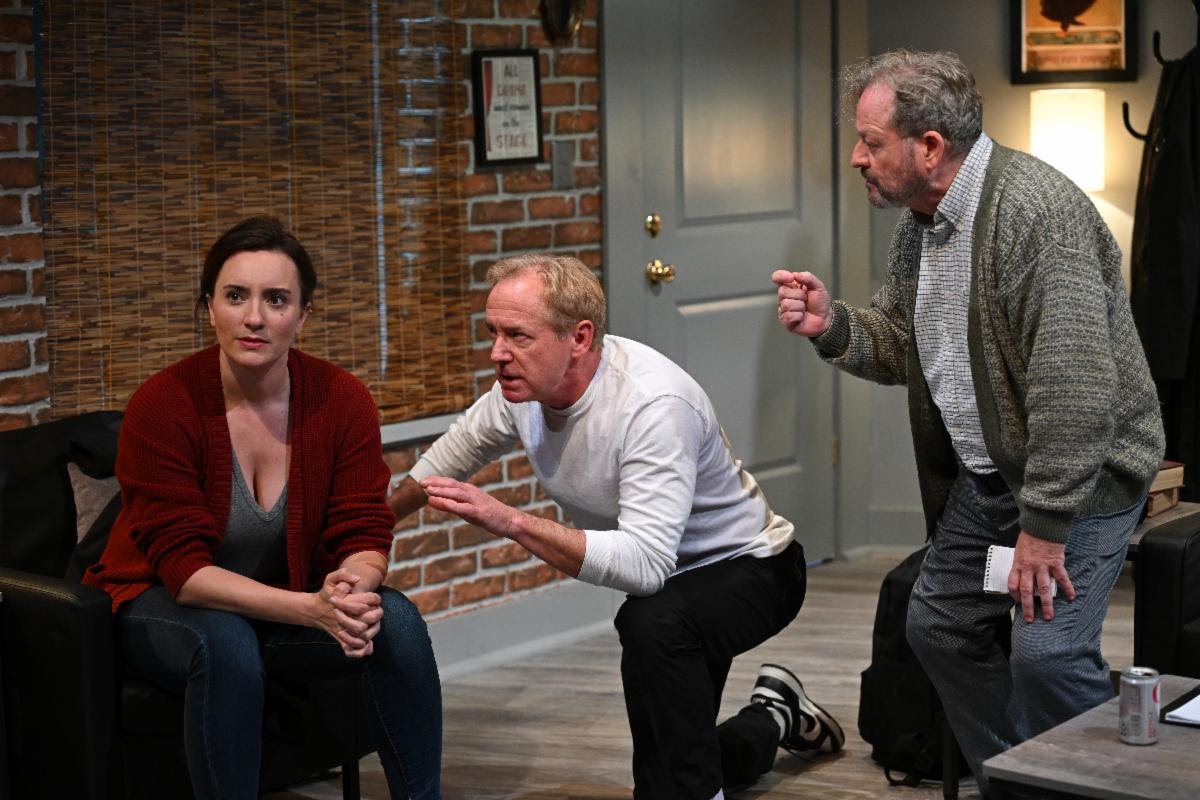
The script comes to life thanks to the efforts of the show’s cast. Eddie Kunz amusingly leads the charge as Guy Chambers, a playwright who just so happens to be the butt of many jokes. Writers are the worst. Completing him comedically is his satisfyingly sardonic sister, Judy Chambers, played by Trinity Griffin. The two have a fun dynamic that propels parts of the plot. Jordan Coury is a delight as Henry Chambers, the pretentious relative who makes a living reviewing wine. That might be my next step. His physicality and penchant for peculiar pronunciation are highlights of his scenes. Nicole Brady is a lot of fun as Piper Banks, an aspiring actress and a cousin to many of the others, although the latter doesn’t prevent Guy from becoming enamored with her. Mary Ann Chambers, the last member of the family, is given an electrified performance by Gina Preciado. Jon Poli joins her as Bramwell Tripp, a rather amorous hanger-on. Equally silly and sleazy, Poli is a great addition to the fold. Rounding out the cast are Tom Sarp and Mary Randolph as Rogers and Dolores, respectively. The servants of the estate, the duo provide a fair share of laughs, especially with their comic disfigurements.

Nicole Brady and Jordan Coury.

Of course, the technical elements of the show do some heavy lifting as well. Playing into a story included in the program, ghosts from the company’s past make their presence known by toying around with the lights and sound. Pamela Cashdollar is the one responsible for wrangling them, in addition to her duties as the show’s photographer. Otherwise, the behind-the-scenes contributions are helmed by an army of hardworking, flesh-and-blood individuals. Set designer Robert Hockenberry masterminded the detailed set. Audio is made possible by Dan Sterzinger who runs sound and Britt Pierce, who designed it. Similarly, Barbara Sawatis runs the lighting designed by Wendy L. Rea. Samantha Sanford executes special effects and makeup, while Shawn Karabinos handled the show’s graphic design work. None of this would even be possible without the expert guidance of the stage manager, Gretchen Beck.

Margaret Partee Performing Arts Center is a quaint venue in the heart of Bellevue, PA. Although on the smaller side, it hosts an impressive array of events and performances, most of which are plays by the Pittsburgh Savoyards. Along with The Rage of the Stage Players, The Haunted Theatre Company has established a residence in the space, wonderful news for the creative scene in the North Boros.

Despite the spooky history detailed in the programs, The Haunted Theatre Company is a new artistic outfit proposing to produce five seasons of entertaining shows. Headed by writer and director Michael McGovern, the group is set to realize that goal with a second production slated for the fall.

-JS

Wine and Spirits continues its run May 14th-16th at 8 pm and May 17th at 2 pm. at Margaret Partee Performing Arts Center in Bellevue, PA. For tickets and more information, click here

A Great Feast of Theatrical Languages – A Review of Love’s Labour’s Lost

By Timothy Ruppert

Want a challenge? Stage William Shakespeare’s infrequently produced early comedy, Love’s Labour’s Lost, knowing fully well how few audience members will have any significant familiarity with the play beyond its alliterative title. Oh, and do so with paper puppets projected onto a screen. And throw in a singalong with the audience to close out the festivities. Interested?

Steel City Shakespeare Center accepts that challenge with verve and vision, proving that they are a theatre company meriting serious attention in the Pittsburgh arts community. Beautifully designed and superbly executed, their production of Love’s Labour’s Lost fashions a unique, not-to-be-missed theatrical experience.

The play itself begins with what seems an outrageously difficult task when King Ferdinand of Navarre (Aaron Crutchfield) charges three high-ranking courtiers—Berowne, Dumaine, and Longaville (the first two voiced by Bob Colbert, the third by Matthew Hartman)—to forego all physical gratification for the sake of scholarly pursuits: “Our court shall be a little academe,” boasts the sovereign, “Still and contemplative in living art” (1.1.13-14). This royal fiat—which includes an edict forbidding any woman within a mile of court—swiftly becomes a sticky wicket once the Princess of France (Anne Forrest) arrives with her entourage of ladies (Sarah Elizabeth as Maria and Ella Mizera as Rosaline and Katherine), sparking love and romance in place of arcane intellection. What follows is a mélange of elements that recur throughout Shakespearean comedy: the verbal fencing of eventual lovers so well beloved in Much Ado About Nothing; disguises and misidentifications such as we find in Twelfth Night and As You Like It; and a metatheatrical sequence that presages the work of Peter Quince and friends in A Midsummer Night’s Dream. We get a few important surprises, too, making Love’s Labour’s Lost a distinctive presence in the Shakespeare canon.

Shakespearean puppetry.

Álvaro Muñoz as the braggart Don Adriano de Armado and Joseph Vasquez as his page, Moth, complete a terrific cast of voice actors whose passion for their craft resonates throughout the evening. While Colbert, one of Pittsburgh’s best interpreters of Shakespeare, delivers an expectedly splendid performance (and he plays the accordion to boot), the actors prove to be impressive.

Director Cat Aceto deserves special notice for her designs and puppeteering. Along with Skylar Rella and Jenna Simmons, Aceto treats us to a striking display of shadow-theatre storytelling. The puppets are wonderfully constructed and varied, combining human forms with the heads of assorted animals—deer, rabbits, giraffes, owls, and many beyond—to render a theriocephalic spectacle that puts us in mind of folkloric magic generally and of Nick Bottom’s adventures among the fairies specifically. Together with the cast’s keen performances, the puppetry truly elevates this production to a remarkable level of achievement.

Not surprisingly, Steel City Shakespeare Center scores a very palpable hit with their current showing of Love’s Labour’s Lost. The company takes artistic risks with alacrity, in part because the talent and imagination of this troupe’s members ensure success. To paraphrase Moth (5.1.35), this production offers a great feast of theatrical languages—voice acting, puppetry, music-making—certain to delight newcomers to the Bard as surely as it will please connoisseurs.

-TR

Steel City Shakespeare Center’s production of “Love’s Labour’s Lost” continues 15 and 16 May, 7.00 PM, at the Tracey D. Turner Studio, Northmont United Presbyterian Church, 8169 Perry Highway, Pittsburgh, PA 15237. For information and tickets, please visit here.


Molto Benne – a review of “Jitney”

By Michael Buzzelli

It’s 1977 in Pittsburgh’s Hill District. The stage is set for another production of August Wilson’s “Jitney,” but this version is unlike any other version you’ve seen. The play is in Italian with English supertitles. Five astonishing actors take on nine parts.

The production is a collaboration between Pittsburgh Playwrights Theatre Company, Sardegna Teatro, and La Piccionaia.

Becker (Miguel Gobbo Diaz) runs a maybe-not-completely-legal cab service in the Hill District, driving customers to the closest Giant Eagle and points beyond. In between rides, he hangs out with his fellow Jitney drivers: Turnbo (Marcos Piacentini), Youngblood (Tomiwa Samson Segun Aina), Doub, and Fielding (Fredrico Lima Roque).

It’s not a cohesive workplace.

The masculine energies clash constantly. The drivers can’t even get through a friendly game of checkers.

Turnbo, who can be an instigator, constantly picks at the volatile Youngblood, a Vietnam vet.  Fielding drinks too much. Youngblood is keeping a big secret from his girlfriend, Rena (Rosanna Sparapano).

After 20 years, Becker’s son, Booster (Piacentini again), is released from jail after serving a sentence for murder.

There is a raw, visceral appeal to the performances. If you take your eyes off the words, you can feel the emotions flowing between the actors.

Youngblood (Tomiwa Samson Segun Aina) Rena (Rosanna Sparapano) reconcile while Turnbo (Marcos Piacentini) enters.

Piacentini’s Turnbo and Booster are vastly different characters; his speech patterns, the timbre of his voice, and his every movement set them apart (not just the slight costume changes).

Five reasons to go: Miguel Gobbo Diaz, Federico Lima Roque, Rosanna
Sparapano, Tomiwa Samson Segun Aina and Marcos Piacentini.

Diaz and Piacentini’s tumultuous relationship is one of the play’s many highlights. They tear at each other mentally and spiritually. It’s powerful theater.

Sparapano is another chameleon in the show, playing Rena and Philmore. They are also very distinct. Sparapano is charismatic on stage, especially when she’s playing Rena (wearing a piled-high, vibrant yellow turban). Sparapano also gives the play a break from the machismo. Youngblood becomes vulnerable around her. It’s a decidedly different side of his personality.

Samson Segun Aina’s Youngblood is brilliant, oozing with masculine charm, a powder keg of raw emotions.

There are some English translation differences. “Put the gun UP,” instead of the more American “Put the gun DOWN.” An electronic sandwich board displays cab fares with the dollar sign after the amount, as is normal with lira or Euro, not “bucks.”

The stage is nearly barren, but director Renzo Carbonera gives us a very Pittsburgh palette. Everything is black and gold. He also fills the transitions between scenes with interstitial film footage from 70s Pittsburgh (sound and video by Filippo Cossu), along with slow-motion choreography that enhances the upcoming content moments before the actors begin their scenes.

It’s more than molte benne, it’s meravigliosa!

-MB

Jitney” runs May 8th – May 10th 2026 at the Carter Woodson Redwood Theater, inside the Madison Arts and Entertainment Center, 3401 Milwaukee Street, Pittsburgh, PA 15219. For more information, click here.

Dear Evan Hansen Delivers the Message

Reviewed by Dr. Tiffany Knight Raymond, PhD, and Theron Raymond (7th grade)

Pittsburgh Musical Theater brings Dear Evan Hansen to the stage. It’s about teen suicide, specifically the suicide of a teenager named Connor Murphy (Joshua Clark). The dark subject matter is not characteristically musical-like, and since most of the songs are solos, Lucas Fedele’s choreography becomes more of an afterthought.

Connor snags a letter Evan (Anthony Marino Jr.) has written to himself out of the high school computer lab printer. It’s an assignment from Evan’s therapist. When Connor’s body is found, the note is on his person. Since it’s addressed to “Dear Evan Hansen” and signed “me,” Connor is presumed to be the author.

Tucker Topel’s set design is spare. A large frame at a canted angle arches over the stage, and other posts extend upward to anchor it. These towering elements are lit in varying colors to signify different characters and moods. They’re often overlaid with projections from visual media designer Scott Andrew. While striking, they don’t have as much visual impact as they could because of the frames’ narrowness.

Evan is a milquetoast and doesn’t speak the truth when he learns about Connor’s passing and the note from Connor’s parents. In his effort to provide comfort, Evan slides into assuming the role of Connor’s best friend, despite the fact that they barely knew each other. Evan’s long-term obsession with Connor’s younger sister, Zoe (Erin Cain), significantly complicates his motives to nurture his relationship with the Murphys.

Anthony Marino Jr. as Evan Hansen. Photo Credit: Matt Polk

Connor struggled with substance abuse and was both feared and disliked. Ironically, it is only through Evan that Connor comes to life – and becomes likable. But the same is true for Evan. Evan goes from weird outcast to popular by association. Connor’s death creates a viral moment that people want to associate with. The play explores the lengths one goes to in order to extend a moment and keep something significant when the world is constantly moving on. In a world of social media-driven attention spans, new tragedies and events continually draw us in other directions.

Director Tim Seib has Marino lean into a disarmingly quiet presence that brings both Connor and Evan to life through storytelling. Their fictional friendship reflects a heart-achingly real wish for connection. Evan’s only friends are his “family friend” Jared (Max Milligan) and another socially awkward classmate, Alana (Maya Fullard). Both Fullard and Milligan create memorable supporting characters without overplaying their roles. Fullard continually talks over Marino to corner her own piece of Connor’s memory, reminding his parents she was one of his “best acquaintances,” and you can see the wheels spinning as she wants to parlay the moment into a college application essay.

Evan loves trees; nature provides a companionship and comfort he can’t find with humans. It’s not accidental that the fictional friendship takes place at an abandoned apple orchard that Connor used to visit with his family. Apples are symbols of temptation, and Evan succumbs to the temptation to keep elaborating on this fictional friendship to draw closer to the Murphy family. They’re upper-middle-class and embrace Evan. This contrasts with Evan’s hard-working single mom, who’s rarely home as she struggles to make ends meet as a nurse’s aide while also completing her education. Her absence in Evan’s life is understandable, but it’s one more dimension of his loneliness that is countered by the affirmation and attention the Murphys give him.

You know this house of cards must eventually collapse, and that anticipation heightens as Evan is caught in a swirl of his own lies that is at odds with the genuine affection he has for the Murphys and his attraction to Zoe. While Steven Levenson’s book elides climactic confrontation, the staging dynamically compensates. The musical opens with the two moms in a duet, singing about “making this up as I go.” It’s not just a line about parenting but about life, and Dear Evan Hansen inspires deeper discussions about how we each make it up as we go. Those choices can never be perfect, but thanks to Dear Evan Hansen, they do inspire reflection.

-TRK, Ph.D. & TR

Pittsburgh Musical Theater’s production of Dear Evan Hansen runs through May 24, 2026, at the Gargaro Theatre, 327 S. Main Street, Pittsburgh, PA 15220. Purchase tickets online here.

css.php